

About chrt for Forwarders
Manage shipment work
CHRT brings the shipment route, cargo, tasks, tracking, messages, and proof into an order workspace. Provider teams coordinate and execute shipment legs for their customers. Use the sections relevant to your work and check the saved state before treating a change as complete.
Build and follow the route
Use Timeline to inspect shipment legs and stops. Ground, flight, and onboard-courier segments represent different transport work. Add the locations, contacts, time requirements, cargo, and proof requirements the people performing the work need.
The options are Ground Segment 1, Flight Segment 2 and Onboard courier 3, from the Add Segment button 4.
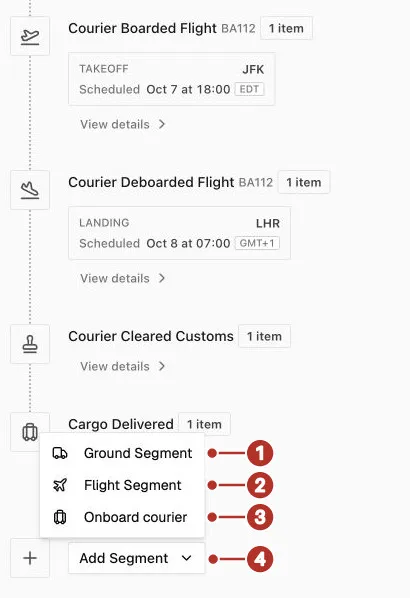
The Add Segment menu at the bottom of an order’s Timeline tab. 1 Ground Segment, 2 Flight Segment, 3 Onboard courier, 4 Add Segment button, which opens this menu.
Air cargo
CHRT supports air-cargo search, quotes, booking, e-AWB submission, and AWB track and trace. Confirm your organization’s access and shipment prerequisites before using these capabilities. See Flights and Air Cargo.
Keep proof with its task
Task artifacts support images, files, signatures, scans, and other evidence. Inspect the actual completed artifact and associated task. A proof requirement describes what should be captured; it does not guarantee that evidence has already been collected or that a compliance obligation is satisfied.
Connect your working partners
Use Orgs to manage the relationships available to your organization. Provider mode distinguishes Shippers, Executors, Coordinators, and Vendors. Review the saved relationship and contact information before assigning work.
Read tracking with its source
Review the map’s available tracking sources and update times. Driver location and device observations provide different information. Shipments without a reporting source do not gain live location simply because an order exists.
Route updates to your team
Configure organization groups and personal notification preferences for the available events/channels. Webhook settings support integrations with receiving systems. Verify delivery separately from saving the configuration.
Manage your network
- Connect with shippers who need forwarding and couriers who can execute legs. Connections are free and unlimited.
- Default rate sheets attach per connection so pricing auto-applies on new orders.
Billing and rate sheets
- Rate sheets — define pricing for shipper-to-you and you-to-courier on each leg.
- Line item groups — auto-generated per task group with base rates, mileage, surcharges, and adjustments.
- Statements — group line items into invoiceable units; one per order for forwarders and shippers, one per task group for couriers.
- Stripe Connect — collect from shippers and pay couriers through the same payment processor.
- Ledgers — roll statements into weekly or monthly billing periods per counterparty.
Cargo types
When building orders, you specify the type for each cargo item, which drives handling requirements and pricing.
Getting started
For billing workflows and rate configuration, see Billing.