

Glossary
Shared vocabulary for orders, work, tracking and organizations.
Use this index with the relevant concept guide and the labels in your current workspace. Operational terms describe the configured work; saved state and access still need to be checked.
The order Summary shows several of these terms: the Route 1, the Cargo grid 2 and the Executors and Ownership 3.
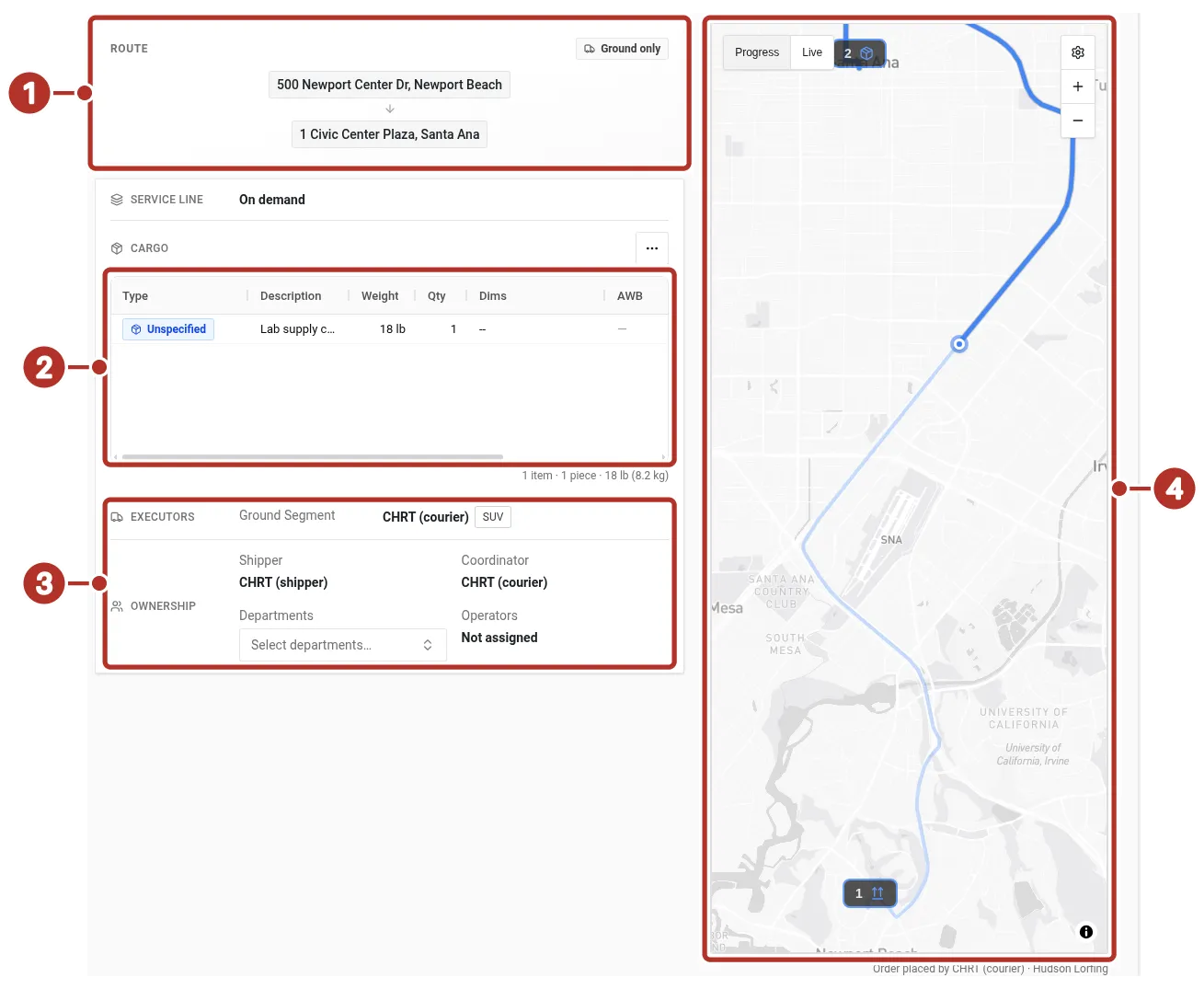
The Summary tab of an order in progress. 1 Route panel, 2 Cargo grid, 3 Executors and Ownership, 4 map with Progress and Live.
A
- Active connection — A connection both sides have accepted; orders can be assigned across it.
- Admin — Organization role used for membership and privileged administration. Resource-specific access still applies. See Roles.
- Adjustment — A manual change to a line item’s amount on a line item group.
B
- Base mileage — The flat-rate distance band on a ground rate
sheet (e.g.
$25 for the first 15 miles). - Billing ledger — Optional grouping of statements between two parties across a recurring period.
C
- Cargo — What’s being moved on an order. Review the cargo records associated with each task.
- Cargo type — Classification describing what is moving. Confirm the actual handling requirements and available form options. See Cargo types.
- Connection — Link between two orgs on chrt. See Connections.
- Connect handle — Public org handle (e.g.
@acme-couriers) that drives the profile URL. See Connections. - Courier — A provider who runs the work directly.
D
- Default rate sheet — Rate sheet auto-applied to orders across a given connection.
- Directory — Public organization discovery. Confirm the actual provider profile and saved connection before assigning work.
- Draft order — Work being prepared in the order workspace before staging. A reference or preview does not prove it is ready to execute.
- Driver — A user with a linked driver profile in an eligible active organization. Membership alone does not establish driver access. See Roles.
E
- ETA — An estimated arrival time. Read its inputs and freshness; it is not a guaranteed arrival. See Tracking.
- Earnings — Statements where your org is the payment destination (money in).
- Expenses — Statements where your org is the payment origin (money out).
F
- Forwarder — A provider who brokers work to couriers rather than driving it directly.
- FlightAware — The third-party feed chrt uses for flight departure, arrival, and tracking data.
G
- Ground task group — A task group of type
chrt_ground_provider— picked up and delivered by ground couriers. See Orders.
H
- Handle — See Connect handle.
L
- Ledger — See Billing ledger.
- Line item — A single chargeable component on a line item group (e.g.
base_rate,additional_mileage,fuel). - Line item group (LIG) — The full set of line items for one task group, generated from a rate sheet. See Billing primitives.
M
- Member — The least-privileged default role for assigned driver work. A linked driver profile and eligible organization are separate prerequisites.
- Milestone — A recorded operational event. Check the task, proof or integration source establishing it.
- Mode — The organization type selected during setup, such as Shipper or Provider. Separate from a user role.
O
- OBC — On-board courier. A task group of type
onboard_courierwhere a person hand-carries cargo through pickup, flight(s), and delivery. - Off-platform — A connection record for a partner who doesn’t have a chrt account. See Connections.
- On-platform — A connection where both sides have chrt accounts.
- Operator — Organization role for operational coordination where the organization and resource permit it. See Roles.
- Order — The shipper-facing record of a shipment. See Orders.
- Owner — Highest org role; the org’s principal.
P
- Payment vector — Directional billing relationship: SPP, PPP, or PPD. See Billing primitives.
- PPD —
provider_pay_driver. A courier paying their own driver. - PPP —
provider_pay_provider. A forwarder paying a downstream courier. - Provider — An org in
providermode — covers both forwarders and couriers. See Connections. - Public link — A shared tracking URL. Review the actual recipient view and relevant sharing controls. Collection, sharing and deletion are separate outcomes.
R
- Rate sheet — Pricing template that attaches to a task group to generate billable line items. See Billing primitives.
- Rate sheet kind —
ground,flights, orobc. One kind per task group type.
S
- Segment — Operational label for a unit of related work; review its task group, executor and cargo in the current workspace.
- Settlement type —
stripe_connect(chrt issues a Stripe invoice) oroff_chrt(settle outside chrt). - Shipper — An org in
shippermode that places orders and pays for them. - SPP —
shipper_pay_provider. A provider charging the shipper. - Staged — Submitted and awaiting work. Applies to orders, task groups, statements, and line item groups.
- Statement — Bundle of one or more line item groups that becomes an invoice or settlement. See Billing primitives.
- Stop — Operational place/action in a route. Check its configured tasks and proof requirements.
- Stripe Connect — The integration chrt uses to issue invoices and receive payouts on behalf of payee orgs.
T
- Task — One action at one location (
pickup,deliver, etc.) inside a task group. See Orders. - Task group — One continuous unit of work on an order, assigned to one party. See Orders.
- Tender — The act of handing cargo to an airline at an airport
(
tender_to_airline). - Time window — Earliest and latest acceptable times for a task. Used by ETA and dispatch.
- Tracker session — A window of recording for a tracker device. See Tracking.
- Tracking session — See Tracker session.
V
- Vehicle type — Vehicle classification. Confirm the available options and suitability for the planned work; a category does not prove carrier qualification.